Welcome to the Neighborhood Acupuncture Place!

Here you will find answers to your questions about acupuncture as well as simple natural remedies.

Thanks for stopping by.


Powered by Love a Local Business.

Thursday, March 11, 2010

Qi Gong

Qi Gong


I apologize for those of you who wait with baited breath each Tuesday for the new blog posting and did not find one. I was attending a 4 day Qi Gong seminar called the Qi Revolution. If you've never heard of it, as I never did until I received a postcard about a 32 hour CEU program for $99 let me give a few details.


Supreme Science Qi Gong is a non-profit organization that teaches massage therapists, nurses, acupuncturists and anyone who is interested how to use qi gong to live a healthier life while offering super affordable continuing education credits.


You might be wondering what in the world is qi gong. I'll start first with the pronunciation. Qi = chee, Gong = gong. Qi Gong is a branch of Chinese Medicine and is a form of gentle exercise and cultivation of energy with meditation mixed in.


Benefits of Qi Gong include: (taken straight from the Qi Gong training manual)

>>improves the motion of blood, warms the blood, and enhances whole body circulation

>>stimulates appetite, sexual function, assimilation of nutrients and digestion/elimination

>>accelerates metabolism, weight loss, decreases need for sleep

>>bolsters immune system by reducing cortisol

>>develops dexterity, reflexes, and prevents osteoporosis

>>opens arteries allowering greater brain-based microcirculation to prevent alzheimers

>>enhances mental acuity, focus and concentration

>>helps us to calm down and relax

>>improves results of hands on healing and helps spiritual growth


Qi Gong is the discipline of harnessing your energy. It is similar to Tai Chi although for most forms you stand in one place and work more with moving your hands and arms following your breath. For more information about qi gong you might visit here.


The list of benefits sounds compelling doesn't it and the fact that it doesn't appear to be as physically intense as say, running a marathon, almost seems too good to be true.


From my experience over the last 32 hours of qi emersion I will say this: Qi Gong is a powerful practice. I wouldn't think holding my hands at chest level and trying to breath would be so intense but then my feet would pulse and burn, my shoulders would fatigue, I'd forget to stay relaxed and hold my breath.


As I sit here listening to devaproject (music from the weekend) trying to find the right words to explain all that I learned over this 4 day class my only thought is this: it was a well thought out production and its presentation was responsible.


What this means is that it wasn't all just about qi gong forms, it was about balance. Jeff Primack was intent on letting the group of 900 know that all the qi gong in the world is not the end all be all of being healthy and living your best life. In addition to practicing qi gong proper nutrition is key (something none of us really ever want to hear) and so is your mind set (negative thoughts and holding on to negative emotions are just as damaging to our health as McDonalds).


There have been studies done in Washington DC where groups have gathered to meditate and crime rates have dropped. I was curious what kind of impact 900 qi gongers would have on Chicago but have no idea where to find such stats on 4 days. We did do several meditations on love, forgiveness, and world peace. So if at any point from March 6-9 you felt a moment of peace I'd be curious to know about it. At any rate, it has defiantly changed my life.


Qi Gong is not like working out at the gym where missing a couple days doesn't dramatically impact the body, its something that must be practiced every day. I made the 30 day challenge, to practice qi gong every day for 30 days. It was said we really wouldn't understand or feel the effects until at least this milestone. Today is day 2 of my personal qi gong practice. I've woken up at 6 each morning to get my practice in, something that if you know me especially recently is almost a superhuman feat. (i like my sleep) So far I'm finding that my sleep is deeper and I'm able to fall asleep quicker probably because my mind doesn't race as quickly either. My appetite and energy level is hearty and so are my bowel movements. (sorry if you didn't want to know)


Sarah Zender LAc
Neighborhood Acupuncture Place (NAP)
230 Florence St
Crystal Lake IL 60014
815.893.9825
www.clnap.com 

Tuesday, March 2, 2010

Acupuncture and Grief

Acupuncture and Grief

In Chinese Medical theory the lungs control respiration, dominate theqi, skin, and hair and are impacted by grief. Through the inhale the lungs take in fresh oxygen and energy from the external environment and through the exhale release waste build up from the internal body. This is known as "getting rid of the stale and taking in the fresh" and is why proper breathing is so important.

When the lung function is normal, respiration will be smooth and unobstructed. When the energy of the lungs is deficient there can be feeble speech, weak breathing patterns, shortness of breath, and general lassitude.

The lungs distribute energy to the rest of the body via the inhalation as well as assisting in warming and moistening the muscles, skin, and hair.

The lungs control the skin and hair because these serve as a protective barrier to the internal body controlling the wei qi or immune system. Because the lungs work so intimately with the skin and hair they are often all affected when an imbalance takes place.

We've already discussed how the lungs are affected during colds in this previous blog. What I'd like to touch on today is how the lungs are impacted during periods of grief.

Grief can happen during any transitional period of life, not just when experiencing grief of a loved one. Often times when we are making changes in our lives either through moving into a new living space, starting a new school program, ending a relationship, or are a part of a loved ones death the lung can be weakened, especially if the transition is sudden or there is resistance.

Examples (names have been changed to protect patient confidentiality)

When Jane's father was dying from cancer her hair started falling out and would grow back smelling burnt and unhealthy. Ten years later she still has not fully grieved the loss of her father and suffers from chronic fatigue, fibromyalgia, dry skin, acne, and other nervous system conditions. In this case the lung has been weakened over the initial grief of her father and years of repression and now the lung is not able to bring in or distribute energy efficiently. Her breath is shallow and her posture is slumped forward. When shereceives acupuncture she reports a sensation of being cleaned out and feels lighter with less physical pain.

Lauren spent years at a job where she was under appreciated but did not leave because of her fear of change. One day she discovered that her position would be taken over by someone else and she was forced into leaving. Although on one level she was happy to be free of this job, it was a scary transition. Instead of taking time to grieve the loss of this job she dove into projects around the house and diligently looked for a new job. Her resourcefulness paid off and she found new employment quickly. However, through this tumultuous time in her life she developed a sinus infection and tension increased in her upper body especially around her assessory breathing muscles. Her grief finally caught up with her and her body forced her to rest. Her sinus infections were recurrent for almost 3 months until she had made peace with her old job and settled into her new one.

Especially during times of transition and stress remember to take a time out and a deep breath. Refer back to the blog Change Your Breath, Change How You Feel for breathing exercises and a more in depth explanation about how important proper breathing is.

Whether it is environmental changes during seasonal transitions or life cycle changes our delicate organ the lung is most affected. Acupuncture can assist the body, mind, and emotions to gracefully move through these transitions offering not only a place for your body to heal but a quiet time of reflection as well.

Sarah Zender LAc
Neighborhood Acupuncture Place (NAP)
230 Florence St
Crystal Lake IL 60014
815.893.9825
www.clnap.com 

Tuesday, February 23, 2010

Why Does My Acupuncturist Feel My Pulse?

Why Does My Acupuncturist Feel My Pulse?

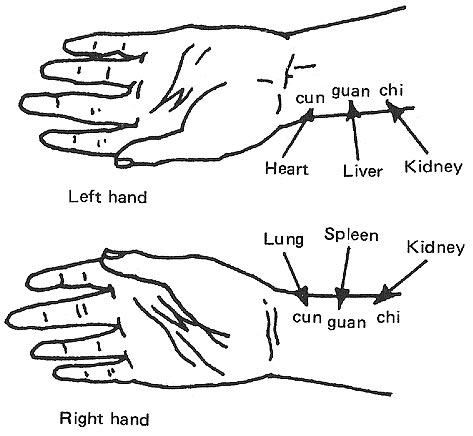
Feeling pulses on both wrists is a simple diagnostic tool used by an acupuncturist to assess how the body is working. Like the tongue, the pulses offer a plethora of information and are seen as a road map.

Three pulses are felt on both wrists as seen in the picture above.

The left wrist represents Heart, Liver and Kidney (yin). The right wrist represents Lung, Spleen, and Kidney (yang).

A western medical practitioner will feel the pulse to count beats per minute. An acupuncturist will feel each wrist with the pads of her left index, middle, and ring finger.

These 3 fingers will assess a pulse: heart and lung pulses with the index finger, liver and spleen pulses with middle finger, and kidney pulses with ring fingers. The acupuncturist is looking for not only the rate of the pulse but also the depth and quality.

Many things can be determined by the pulse and can include: emotions, pain, a women's menstrual cycle, if a cold is coming on, or how old or new a condition is to name a few.

Sarah Zender LAc

Neighborhood Acupuncture Place
230 Florence St
Crystal Lake IL 60014
815.983.9825
www.clnap.com