Welcome to the Neighborhood Acupuncture Place!

Here you will find answers to your questions about acupuncture as well as simple natural remedies.

Thanks for stopping by.


Powered by Love a Local Business.

Tuesday, February 23, 2010

Why Does My Acupuncturist Feel My Pulse?

Why Does My Acupuncturist Feel My Pulse?

Feeling pulses on both wrists is a simple diagnostic tool used by an acupuncturist to assess how the body is working. Like the tongue, the pulses offer a plethora of information and are seen as a road map.

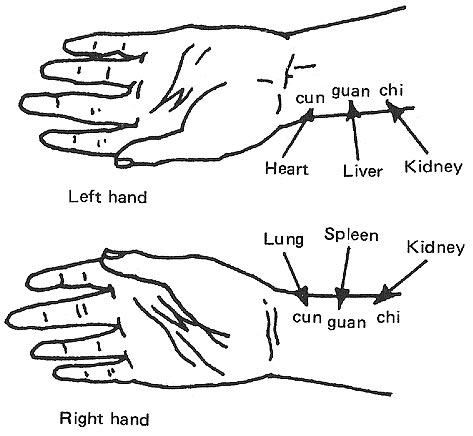
Three pulses are felt on both wrists as seen in the picture above.

The left wrist represents Heart, Liver and Kidney (yin). The right wrist represents Lung, Spleen, and Kidney (yang).

A western medical practitioner will feel the pulse to count beats per minute. An acupuncturist will feel each wrist with the pads of her left index, middle, and ring finger.

These 3 fingers will assess a pulse: heart and lung pulses with the index finger, liver and spleen pulses with middle finger, and kidney pulses with ring fingers. The acupuncturist is looking for not only the rate of the pulse but also the depth and quality.

Many things can be determined by the pulse and can include: emotions, pain, a women's menstrual cycle, if a cold is coming on, or how old or new a condition is to name a few.

Sarah Zender LAc

Neighborhood Acupuncture Place
230 Florence St
Crystal Lake IL 60014
815.983.9825
www.clnap.com 

Monday, February 15, 2010

Why Does My Acupuncturist Look at My Tongue?

Why does my acupuncturist look at my tongue?

Stick out your tongue. This is a common request when working with an acupuncturist.


What are they looking for?


Your tongue is a road map to the rest of your body. The tongue is divided into sections that represent the different organ systems associated with Chinese Medicine.


Tip = Heart/Small Intestine


Just behind the tip = Lungs/Large Instestine


Center = Spleen/Stomach


Sides = Liver/Gall Bladder


Back = Kidney/Urinary Bladder


Your acupuncturist is looking at the size, shape, color and coat of your tongue.


There is no such thing as a good tongue or a bad tongue. The tongue is simply a reflection of how the body is functioning so that the best acupuncture points can be used to adjust the body and allow it to function most optimally.


Over time you might notice your tongue changing. The color or coat might change, cracks may lessen in severity etc.


Sarah Zender LAc

Neighborhood Acupuncture Place (NAP)
230 Florence St
Crystal Lake IL 60014
815.893.9825
www.clnap.com 

Tuesday, February 9, 2010

What is Lavender Essential Oil?

Lavender Essential Oil


Lavender is a scent that many associate with a calm, soothing environment. Images of bubble baths, candles and massage might also come to mind.


Rene Gattefosse a french scientist working in a cosmetic laboratory was the first to discover the benefits of lavender to promote tissue regeneration and speed wound recovery after he burned his arm in a laboratory accident.


Lavender is a highly versatile essential oil and is considered to be an adaptogen. While lavender is known for its calming properties it also has the ability to boost stamina and energy should that be the body's greater need. Therapeutic-grade lavender can be used for a variety of skin conditions as well, from keeping the skin soft and supple to soothing and cleaning small cuts and bruises. My personal favorite in the summer time is to use lavender for minor sun burns also.


University researchers in Japan found that diffusing lavender in office environments improved mental accuracy and concentration and resulted in 20% fewer errors.


University of Miami researchers found that inhalation of lavender oil increased beta waves in the brain, suggesting heightened relaxation. It also reduced depression and improved cognitive performance.


Be careful: true lavender is often extended with hybrid lavender or synthetic linalol and linalyl acetate which strips the potency and purity of the lavender. If the oil you are using says do not apply directly to skin or take internally it is not a therapeutic grade essential oil.


Young Living Essential Oils is one of the few companies in the US that is a therapeutic grade oil company.


Sarah Zender LAc

Neighborhood Acupuncture Place (NAP)
230 Florence St
Crystal Lake IL 60014
815.893.9825
www.clnap.com 
Change Your Breath, Change How You Feel

Change Your Breath, Change How You Feel 

“How you feel effects how you breathe. How you breathe effects how you feel," Sarah Zender


Generalities on Breathing:

You can not be stressed and breathe at the same time. It is not possible.
The breath is linked to the nervous system. Inhaling corresponds to your sympathetic fight or flight response; Exhaling corresponds to your parasympathetic stay and play response. Therefore when the exhale is longer then the inhale, relaxation and healing can occur in the body.

Philosophy of Good Breathing:

Ancient Yogis believed that people have a certain number of breaths to live, not a certain number of years. If you want to see proper breathing watch a baby!

Most people do not breathe efficiently as a result of constricting clothes, poor posture or stress in a situation. Next time you are in a stressful situation take note of how you are breathing. Most times, stress or anxiety can cause the breath to become shallow, rapid and only from the chest or worse yet the breath is held. Redirecting breathing may allow perspective or feelings to be shifted about stressful situations. Also, in a position of poor posture with a rounded back and collapsed spine the diaphragm is unable to fully extend which causes breathing accessory muscles to work harder. (Think about those tight upper traps, levator scapulas and scalenes.)

Improper breathing changes the pH in the body, can cause one to pass out or faint and can even on a smaller scale leave one feeling fatigued and lethargic. Proper breathing is the fastest way to detoxify the body, the liver is actually resting next to the diaphragm. When you breathe your liver breathes with you.


Breath is the mirror of the mind. Here are some examples of what happens to our breath on a day to day basis:

• Fear- gasping for air
• Resisting something- hold the breath
• Anger- short jerky, incomplete breaths
• Fatigue- long inhales through the mouth. Yawn

For optimal health, breathing should be preformed nasally and should be full and rhythmic. The breath should come in through the nose and out through the nose. The nose is anatomically designed to filter and warm the air for the lungs, therefore try to use it as nature intended.

The diaphragm is the primary breathing muscle, accounting for 75% of the power of respiration. In order to breathe efficiently, the abdomen must expand so that the diaphragm has “somewhere to go.” The ribs and intercostals must pull the chest wall out to expand the lungs the rest of the way.

Exhaling breathes should last as long as the inhaling breath. Making the exhalation last twice as long as the inhalation is even more beneficial. By making the exhalation longer, the recoil capacity of the chest increases (slightly) as the second set of intercostals contract to return the rib cage back to its original position. Also, the pressure between the inside and outside of the lungs is exaggerated thus helping to pull more air into the lungs.


Breathing and the Massage Therapist:

Note the way you breathe the next time you give a massage.


Is your mind wandering about the stresses of your life as you are giving a massage? Is your breath shallow or deep with effleurage strokes?

Do you hold your breath when trying to dig into a muscle during friction or do you use your breath to deepen your pressure?

How is your client breathing? What is their response to your massage? Does your client release and relax with your techniques or are they resistant to letting go?

When you touch a person or animal especially for a long period of time your breath links with the person you are touching. Using deep breathing helps facilitate deeper relaxation and stress relief for both parties.

Correct breathing tones the abdominal muscles which can assist in a healthy lower back and reduces stress on the already overstressed upper traps and levator scapulae muscles.


Breathing Exercise:


The easiest way to explore the breath is lying supine. You can also try breathing in a seated or standing posture. Try not to let the mind wander.


Three Part Breath:
1. Lie on a towel rolled lengthwise under your spine. The towel should run from the base of your ribs to support your head comfortably. If you back feels more relaxed with your knees bent bend them.


2. Begin first by becoming aware of your breath. Simply observe the way your breath feels try not to alter or change it. Note where your breath moves in your body and how you feel.


3. Place both hands lightly on your lower abdomen just below the navel. Slowly begin to deepen the breath into your lower belly and feel the rise and fall of your belly as you breathe into this part of your body. Do not force your breath where it is not ready to go start where your body is ready to be and visualize your breath deepening until it is where you would like it to be.


4. Next slide both hands to the other parts of your rib cage and feel your breath expand in your ribs.


5. Keep one hand on the outer rib cage and one hand on the lower belly and feel the breath expand between the lower belly to the rib cage as your inhale and relax first from the ribs to the lower belly as you exhale. Let the breath be relaxed as you inhale and exhale and let the transition from belly to ribs be smooth and seamless.


6. When this two-part movement is comfortable for you imagine your breath starting in the lower belly expanding to the outer rib cage and ending just beneath your clavicles. Let the air you inhale and exhale move in a triangle pattern from belly to ribs to clavicles. Do not force your breath where it is not ready to go start where your body is ready to be and visualize your breath deepening until it is where you would like it to be.


Think about the inhale expanding and rising upwards from the belly to the chest and the exhale falling and returning inward on the exhale. Let go of all of the air in the body before taking the next inhale.

Sarah Zender LAc

Neighborhood Acupuncture Place (NAP)
230 Florence St
Crystal Lake IL 60014
815.893.9825
www.clnap.com 

Monday, February 1, 2010

Getting the Most Out of Your Acupuncture Session

Getting the Most Out of Your Acupuncture Session

A patient recently asked, what’s the deal with this whole resting thing, can’t I just read a book while I’m getting acupuncture?

We talked briefly about the apprehension to have a few moments of silence. There were many things pressing on this patient’s mind and the silence allowed the mind to move too quickly. Patient comfortability is of our highest goal at Whole Health Acupuncture and I devised a treatment that allowed her to read her book. In the end it was her most relaxing session to date.

So why do you have to rest with those needles in?

First and foremost your body heals itself in a restful state. This is why we must sleep every night, to allow the body to repair itself. Have you ever gone a night with no sleep? How did you feel the next day? Tired, achy, crabby? When we are sick we require more sleep so that the body can fight the illness. I often encourage people to go to their “happy place”, telling especially new patients the best thing they can do is to take a little nap for the very same reasons we rest when we are sick: so the body can take over and repair itself. Acupuncture’s goal is to correct imbalances and improve the overall functioning of the body. It’s a stimulus to the body to remember what it already knows what to do: heal itself.

But what about the patient with too much weighing on the mind that finds it hard to sit still? Sometimes reading a book is most restful, although I don’t necessarily endorse it. There is a practice of sitting still, its called meditation, and it can take a long time to enjoy that stillness. In my opinion, our society doesn’t place enough value on relaxation, stillness, or prevention. I think we are all a little out of practice and could benefit from some regular peace and quiet. It is in this still place that patients at Whole Health have reported sensations of their pain intensifying and then completely dissipating, where anxiety has risen and reduced lessening the severity of anxiety in their daily lives, where inspiration has appeared for all sorts of decisions like writing books, making something work better, or has allowed some feeling stressed with many thoughts weighing on their minds when they arrived to leave feeling light and at peace. I sometimes think of the image of a patient receiving acupuncture like being metaphorically nailed down for a moment (the patient really isn’t) so that they are forced to be in the moment if at no other time but for the moment of their treatment. Why would this be a good thing? For starters, to be an active participant in the healing process and to witness the pain leaving the body, the lessening of anxiety, the inspiration etc. A great teacher once said,” awareness precedes change.”

We can’t know what or how to change until we are aware.

What if you’re the one who needs the book during a treatment?


Start with the book! As you are reading be aware of your thoughts and body calming down. When you feel ready spend a minute or two without the book.


Practice some deep breathing. Imagine a big balloon in your belly. Inhale and fill up your balloon (maybe even with those thoughts weighing on your mind). Exhale and deflate your balloon. Make sure your breath is relaxed, not forced and as much as possible keep your focus on a complete exhale.


Take some time to observe (without judgment). I like to start with sounds that feel like distractions and place all of my attention on them. Then I slowly listen for the other softer sounds around me. This usually puts me right to sleep. You might also observe your thoughts (again no judgment) and just notice how those thoughts are affecting you and if they are serving you. Try and replace any negative thoughts especially about yourself into positive thoughts. You can also observe sensations in your body. Often times patients have many sensations during acupuncture: heaviness, lightness, waves and many others.


Use an intention. Why are you here for treatment? If acupuncture is a task to fill in the blank here then use
this time for just that. You might say to yourself a few times, “it is my intention to leave here without pain, to feel energized and relaxed.” The ancients argue that saying an intention 3 times lets the universe know you are serious. Give it a try and see.

If you’ve received acupuncture or are currently receiving acupuncture let us know what helps you get the most out of your treatment.

Sarah Zender LAc

Neighborhood Acupuncture Place (NAP)
230 Florence St
Crystal Lake IL 60014
815.893.9825
www.clnap.com 

Tuesday, January 26, 2010

Raynaud's Disease and Acupuncture

Raynaud's Disease and Acupuncture

Raynaud's Disease sounds almost like a Chinese Medical explanation of imbalance in the body.

The Mayo Clinic describes Raynaud's Disease as being a circulatory disorder that is different from just having cold hands and feet,neuropathy (numbness and tingling in the toes) and frost bite. People suffering from Raynaud's feel extreme coldness in their hands and feet and the skin color can range from white, blue or black depending on severity. When an attack of this cold dissipates feelings of numbness, pricking pain or burning can be felt. For some people this disease can be debilitating. Some doctors encourage patients withRaynaud's to move to warmer areas of the country to stay away from the cold.

Chinese Medical theory looks at external and internal factors that can attack the body when its defenses wei qi or immunity are down. These factors can include wind, cold, heat, dampness, and dryness and can come from the environment: weather outside, or conditions of home or office or diet. For example, raw foods are cold, dairy products produce dampness, and red meat is warming.

When looking at the body from the eastern point of view we are observing the body by looking and feeling. If the hands and feet are white the coldness could be a new imbalance or less severe attackwhereas black hands and feet could mean an older problem or more severe attack of cold.

Because the liver is responsible for the smooth flow of qi and blood throughout the body we might also look for signs of deficient liver blood or stagnation allowing the cold to obstruct the hands and feet.

Liver Blood Deficiency might include pale skin, dizziness, blurring vision, numbness, spasms of the tendons as well as a light period or absent period.

Liver Qi Stagnation might present with irritability and depression, distention or wandering pain along the ribcage, stuffiness in the chest or abdomen, poor appetite, and irregular or painful periods. When liver qi stagnates for a long time is can allow for phlegm to accumulate in the body giving way to another pathogenic attack: damp-phlegm. This could mean that cold and damp weather might cause increases in Raynaud's flare-ups.

Treatment strategy might include dispelling cold and reliving obstruction as well as nourishing the liver blood and free coursing the liver qi.

Acupuncture points will be used to improve circulation of energy and blood while strengthening the body. TDP lamps (infrared lights) as well as moxabustion may be used during acupuncture treatments to warm the body and dispel coldness further.

Sarah Zender LAc

Neighborhood Acupuncture Place (NAP)
230 Florence St
Crystal Lake IL 60014
815.893.9825
www.clnap.com 

Monday, January 18, 2010

How Can Acupuncture Help My Cold?

Can acupuncture help with _______? We get these questions all the time at Neighborhood Acupuncture Place. The easy answer is yes, acupuncture can help with that. I understand that most people need more of an explanation than this. With this in mind the next few blogs will highlight how acupuncture can help with specific ailments.

Eastern and Western approaches to the body and treatment of imbalances occasionally match up and occasionally look very different from each other.

You've probably had a cold before and may have experienced a stuffy nose, sore throat, runny nose, cough, aversion to cold, fever andheadache. Perhaps you were sick for a week and then started to feel better again or maybe your cold lingered for a few weeks. The common cold can come on during any of the four seasons. In western medicine your doctor might tell you your immune system is down or you were around other people with a cold and that's how you "caught" it.

In Chinese Medical theory external wind is thought to be the main cause of the common cold often times bringing with it cold, heat,summerheat or dampness. The Chinese believe that your tai yang channel (or in English the back of your neck) was exposed when you were outside or slept with a window open and the wind attacked your body. The neck could have been left open to attack because of improper clothing, lifestyle imbalances, constitutional deficiencies or a combination of all of these. Wind will commonly bring with it cold, heat and dampness.

Have you ever slept with air conditioning on, a fan blowing on your face or a window open when it was windy outside? Do you remember how you felt the next morning? Perhaps you had a scratchy throat, a crick in your neck, or headache. If your body was strong it might have been able to dispel the wind on its own. If there was already an imbalance in the body making it weak that could be all it took for the scratchy throat and stiff neck to turn into a full blown cold.

Your acupuncturist will be looking for specific patterns to correct. Treating wind-cold will be approached differently then wind-heat as will treating a cold when your qi (energy) is depleted. The complexityof the body rarely fits into a textbook outline.

Wind-cold may present with a strong dislike of coldness, a mild fever, no sweating, headache, aching body, stuffy and/or runny nose, scratchy throat, cough with thin white phlegm and not feeling thirsty.

In this case we are using acupuncture points and herbs that will dispel wind, remove the cold and strengthen the exterior (so that no more wind can get in).

Cinnamon twig is a good herb for wind-cold as it has warming properties and is usually found in herbal formulas used to treat wind-cold.

Self Care Tip: wrap yourself up in blankets and sweat out your cold

Wind-heat may present with a slight or no aversion to cold, fever is more prominent with sweating, headache, cough with thick yellowphlegm, dry or sore swollen throat, stuffy nose with yellow mucus and feeling thirsty.

In this case we are using acupuncture points and herbs to dispel wind, clear heat and strengthen the exterior.


Mint is a good herb for wind-heat as it has cooling properties and is usually found in herbal formulas used to treat wind-heat.

Self Care Tip: drink mint tea

Colds with underlying Qi Energy Deficiency may present with strong aversion to cold, fever, headache, nasal congestion, cough with white phlegm, tiredness, fatigue, and shortness of breath.

In this case we use acupuncture points and herbs to not only dispel wind, remove cold and strengthen the exterior but also to boost qienergy.

Moxabustion (burning an herb called mugwort) over acupuncture points can help to warm the body as well as cultivate more energy.

Cupping or guasha may also be used to dispel wind in any of these cases with special care taken if there is qi deficiency. For more info on cupping read the What is Cupping? blog.

Preventing Colds and Flus


Massage acu points yin tang (space between the eye brows) and LI 4 (highest point in the space between thumb and index finger) with your middle or index finger. Do this 2-3 times a day for 3-5 minutes until skin is slightly red and an aching or distended sensation is felt.

Ask your acupuncturist about herbal formulas that can prevent colds and flus before they start.

Testimony: 
Sarah, I have to thank you (fairly late, i know) for helping me a few weeks ago with my sinus infection. I was amazed at how wonderful I felt during your acupuncture session. I was back to normal and feeling great within a week, so thank you SO much for your skills and compassion!!
-Nicole M.


And a personal testimony to boot. I started to feel a scratchy throat coming on and was losing my voice with just the very beginnings of achiness in my body and heaviness in my chest on Saturday evening. It probably didn't help that I went out into the Chicago wind tunnel that night either. Sunday I did what I could at home: garggled with salt water, spoonfuls of honey, thieves mouthwash and rest. Monday I still wasn't feeling so hot. Kara bled my lu11 on both thumbs and within an hour the heat in the back of my throat dissipated. I rested the remainder of the day and went to bed at 8:00p. This morning my voice is not 100% yet but there is no pain in my throat and the rest of my body feels just fine.


Practical Therapeutics of Traditional Chinese Medicine by Yan Wu was referenced for this blog.


Sarah Zender LAc


Neighborhood Acupuncture Place
230 Florence St
Crystal Lake IL 60014
815.893.9825
www.clnap.com 
What is Cupping